

To ensure that the main gearbox meshes correctly, "tooth alignment" must be performed, otherwise serious faults such as tooth play will occur.
The so-called "tooth alignment" means that when assembling the transmission, the marked teeth on one shaft gear are inserted into the tooth grooves of the two sets of marked teeth on the left and right countershaft transmission gears. When replacing the countershaft assembly, the replacement must be matched.
1.1 First mark any tooth on the input shaft gear, and then mark the tooth on the other side that is symmetrical to it. The number of teeth between the two sets of marks should be equal.
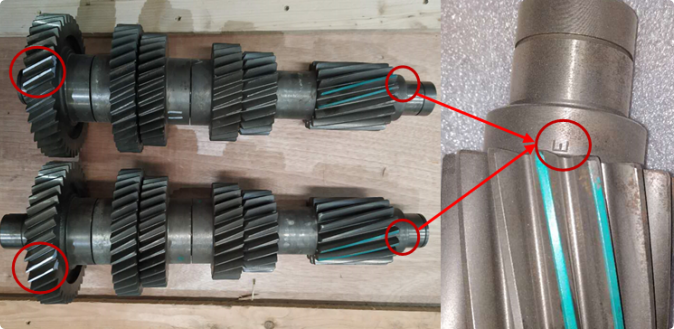
1.2 Mark the two adjacent teeth on the tooth groove corresponding to the "head" on the rear end of each countershaft for identification (the tooth alignment mark is marked when the helical countershaft assembly leaves the factory).
1.3 During assembly, make the marked teeth on the left and right sides of the input shaft gear mesh with the marked tooth grooves on the two countershaft transmission gears.
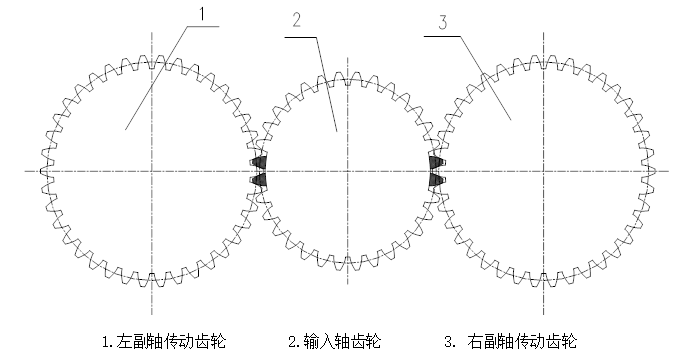
1. 4 Mark any tooth on the input shaft gear, then mark the tooth on the opposite side symmetrically. The number of teeth between the two sets of marks should be equal.
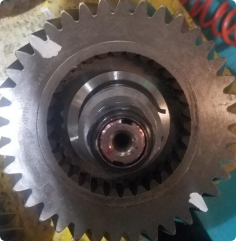
1.5 Find the "head" mark on the rear end of each left and right layshaft assembly, and mark the two adjacent rows of teeth corresponding to the tooth slot where the "head" mark appears. Helical layshaft assemblies are factory-marked.
1.6 Insert the marked tooth on the input shaft gear into the marked tooth slot on each left and right layshaft. Use a lifting tool to lift the mainshaft assembly into the front housing to complete the gear alignment.
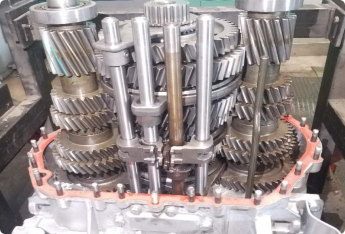
After gear alignment is completed, the assembly diagram is shown.
Move the mainshaft synchronizer (or mainshaft sleeve) and reverse gear sleeve on the mainshaft to neutral. Manually rotate the layshaft assembly. If the shaft assembly rotates normally for several turns, the gear alignment is correct.
If the assembly does not rotate or rotates only a few teeth, the gear alignment is incorrect and requires re-alignment. Correct gear alignment must be ensured before proceeding.
However, when learning about transmission repair, we often encounter the following questions: What is the data flow for each gear?
When encountering a fault, how to accurately determine the problem and take the correct repair method? What is the gear shifting logic of the transmission?
With the increasing demand for AMT automatic transmission maintenance, for repair technicians who have no basic knowledge, lack of understanding, or no experience. A systematic and comprehensive AMT automatic transmission maintenance training course is particularly important. It does not just teach a single knowledge point, but provides comprehensive and systematic teaching. Covering AMT gear data flow explanation AMT circuit diagram reading