
1、The PDU contains numerous contactors
2、The HVCB also features voltage sampling
3、High-voltage distribution board
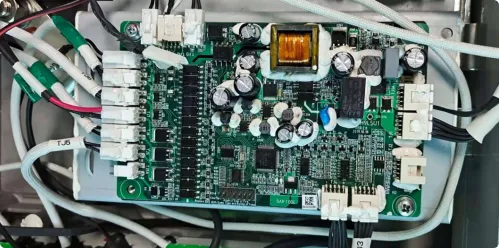
The High-Voltage Control Board (HVCB) serves as the brains of the PDU within a four-in-one vehicle.
Upon receiving a contactor close command from the VCU (Vehicle Control Unit), the HVCB closes the corresponding contactors based on the VCU's instructions and simultaneously monitors each contactor's status, including open, closed, and stuck.
In a four-in-one application, voltage sampling points are located at key locations within the PDU (such as the high-voltage input port and the front and rear contacts of each contactor).
The voltage information collected from these sampling points serves as the logic basis for the HVCB's contactor closing and status reporting.
The HVCB is responsible for reporting the contactor status to the VCU and instrumentation, serving as the logical basis for vehicle control. The HVCB's contactor closing mechanism relies on two principles:
2.1 The VCU issues a close command for the corresponding contactor;
2.2 The power battery voltage is measured at the four-in-one input port.
A contactor closes only when both of these conditions are met. The high-voltage control board also features pre-charge logic. For example, it automatically pre-charges the main motor contactor before engaging it.
The high-voltage distribution board is the hub connecting the main power circuit and various actuators (contactors).
High-voltage power flows from the power battery through the BMS and then enters the four-in-one. Inside the four-in-one, copper busbars and cables conduct the high-voltage power to the high-voltage distribution board.
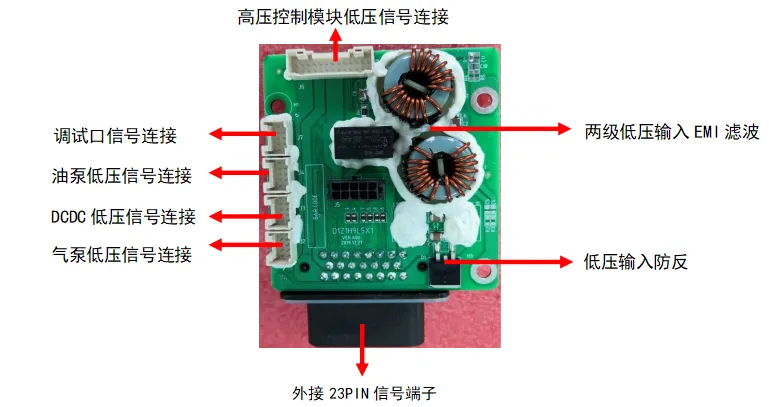
The high-voltage distribution board, in conjunction with the actuators (contactors), distributes high-voltage power throughout the vehicle. Low-voltage control signals are connected to the four-in-one through the plug, filtered by the signal adapter board, and then distributed to various modules and the debug port.
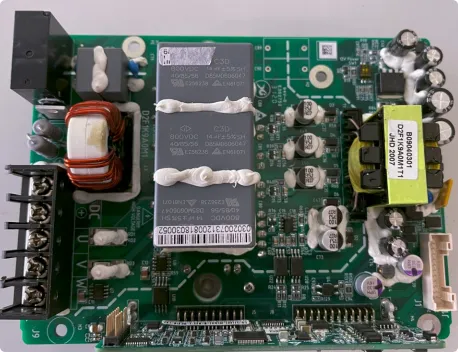
The DCAC module is a power converter that converts input DC to three-phase AC. It serves as the oil/air pump controller in the four-in-one, corresponding to different software and motor control parameters.
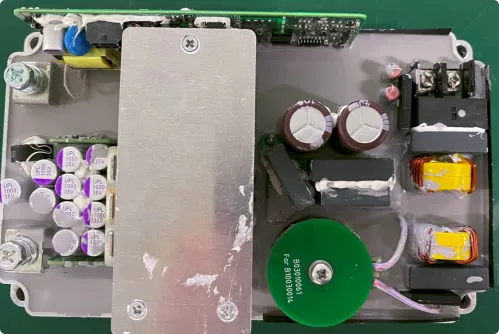
The DCCDC module is a power converter that converts input DC power (400V-750V) to 27.5V DC. It has a rated power of 3kW and a rated output current of 110A.