
1、DPF Differential Pressure Sensor
DTC Description
P245264 Unreliable DPF Differential Pressure Sensor Signal
P244BF0 Excessive Deviation of the Learned Value of the Differential Pressure Sensor
P244B00 Excessive Pressure Differential Across the DPF (DPF), DPF Clogged
P226D09 The DPF is Removed or Failed
P245212 The DPF Differential Pressure Sensor Voltage Signal Exceeds the Upper Limit
P245211 The DPF Differential Pressure Sensor Voltage Signal Exceeds the Lower Limit
The Engine Control Unit (ECU) measures the differential pressure across the DPF using the DPF differential pressure sensor to calculate the accumulated carbon particulates and ash.
• Power Supply Voltage: 5V
• Operating Temperature: -40°C to 130°C
• Measuring Pressure Range: 0 to 100 kPa (Differential Pressure)
The DPF differential pressure sensor consists of a sealed elastic silicon chip and a corresponding bridge circuit. A standard 5V voltage is applied to one end of the bridge. When pressure changes, the silicon chip deforms, the sensor resistance changes accordingly, and a 0 to 5V voltage signal is output to the engine control unit (ECU).
Wiring Harness Link and Actual Location Diagram
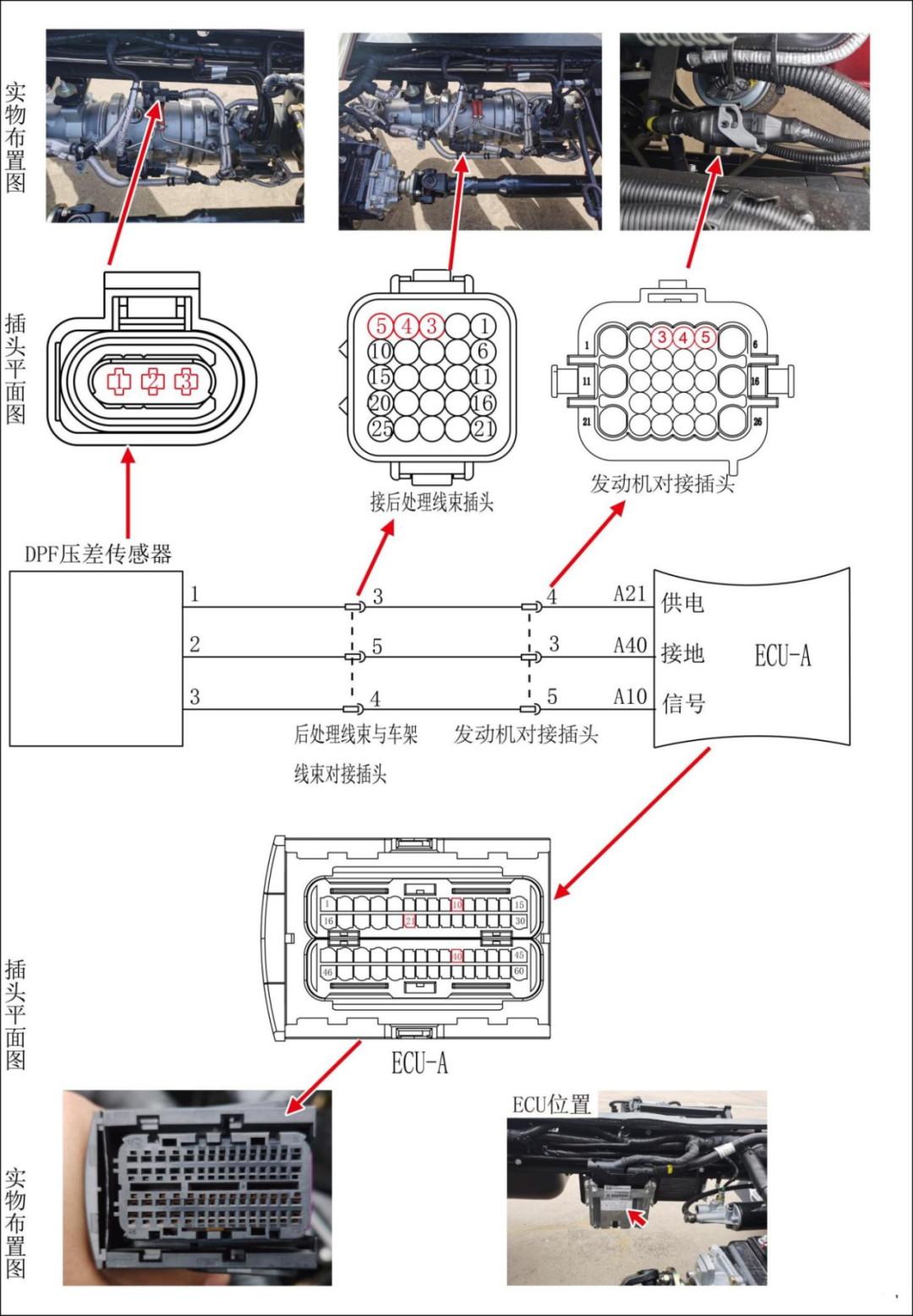
P245212: The DPF differential pressure sensor signal voltage is greater than the set threshold.
P245211: The DPF differential pressure sensor signal voltage is less than the set threshold.
DPF Differential Pressure Sensor Control Circuit Inspection
3.1. Turn the ignition switch OFF and unplug the DPF differential pressure sensor wiring harness connector.
3.2. Turn the ignition switch ON and measure the status of each pin on the DPF differential pressure sensor wiring harness connector.
3.3. Power supply line: The voltage between pin 1 and vehicle ground is normally 5V.
3.4. Ground line: The voltage between pins 1 and 2 is normally 5V.
3.5. Signal line: The voltage between pin 3 and vehicle ground is normally 5V.
Detailed Inspection: Use a multimeter to measure the resistance between pins 1, 2, and 3 of the DPF differential pressure sensor wiring harness connector and pins A21, A40, and A10 of the ECU wiring harness connector to see if it is ≤2Ω.